
Randolph County Sex Offender Checks
The Alabama Law Enforcement Agency maintains the Alabama Sex Offender Registry through its Sex Offender Registry Unit. Randolph County also links to the same official public search. ALEA receives registration data, a current photograph, and fingerprints from local law enforcement, verifies the submission, and enters it in the state system. The public site updates daily from those local submissions. A Randolph County sex offender check therefore begins with the state registry, but questions about a local address or compliance issue return to the Randolph County Sheriff's Office.
Use a known name and location to distinguish people with similar names. Read the offense, address, photograph, vehicle, and status fields together. A public registry entry is not a complete court file, and no result is not proof that a person has no registrable conviction. Alabama excludes some juvenile and youthful-offender matters and some first convictions from public display. Out-of-state, federal, military, or tribal convictions may also need a due-process hearing before publication.
Randolph Registration Starts Locally
Local law enforcement performs the registration work that feeds the Randolph County registry record. The verified local contact is the Randolph County Sheriff's Office and Detention Center at 340 Probilt Drive in Wedowee. The administrative number is (256) 357-4545, option 2. General administrative hours are Monday through Friday, 8:00 a.m. to 4:30 p.m., excluding authorized state and federal holidays. No official Randolph source publishes a separate registry-desk extension, appointment rule, fee, or registration schedule, so call before making a registry-related visit.
Covered adults generally report in person during their birth month and again every three months. That quarterly cycle explains why the local office matters even though ALEA runs the public site. It also explains why a daily online update can still carry a disputed address: the state displays what local law enforcement has submitted, while a registrant may be late, noncompliant, or awaiting verification.
Alabama Sex Offender Registry Searches
Open the official registry from the ALEA registry page or Randolph County sheriff page. Research access reached JavaScript and anti-bot verification before the live Alabama form, so the exact field labels, required fields, radius choices, map controls, and result navigation could not be verified. The safe process is to follow the labels shown on the live official form and avoid assuming controls copied from another state's system.
- Open ALEA's official registry link and read any conditions or disclaimer presented by the live service.
- Use only the search choices shown on the Alabama form. Do not infer that a county, radius, or map control is available.
- Compare any result with known identifiers, then open the public profile to review all posted registration facts.
- Verify a questionable Randolph County address or status with local law enforcement before relying on it.
| Verified Item | Access | Required | Scope Note |
|---|---|---|---|
| Official portal | Free public link | No account advertised by ALEA | Live form may route through a disclaimer or verification screen |
| Search controls | Not verified | Not verified | Exact labels and choices were blocked by the anti-bot gate |
| Public notices | ALEA overview | Not applicable | Not every registrable person is publicly disseminated |
Note: The official Alabama link is verified, but the page does not claim controls that research could not inspect.
Randolph Registry and NSOPW
The Alabama registry is the first source for Randolph County because ALEA and local law enforcement maintain the underlying state data. The Dru Sjodin National Sex Offender Public Website, operated by the U.S. Department of Justice, adds a federated search across participating jurisdictions. It is useful when a person recently moved, has ties to another state, or a family safety check should not stop at the Alabama line.
The Department of Justice source shows how the national search is framed:
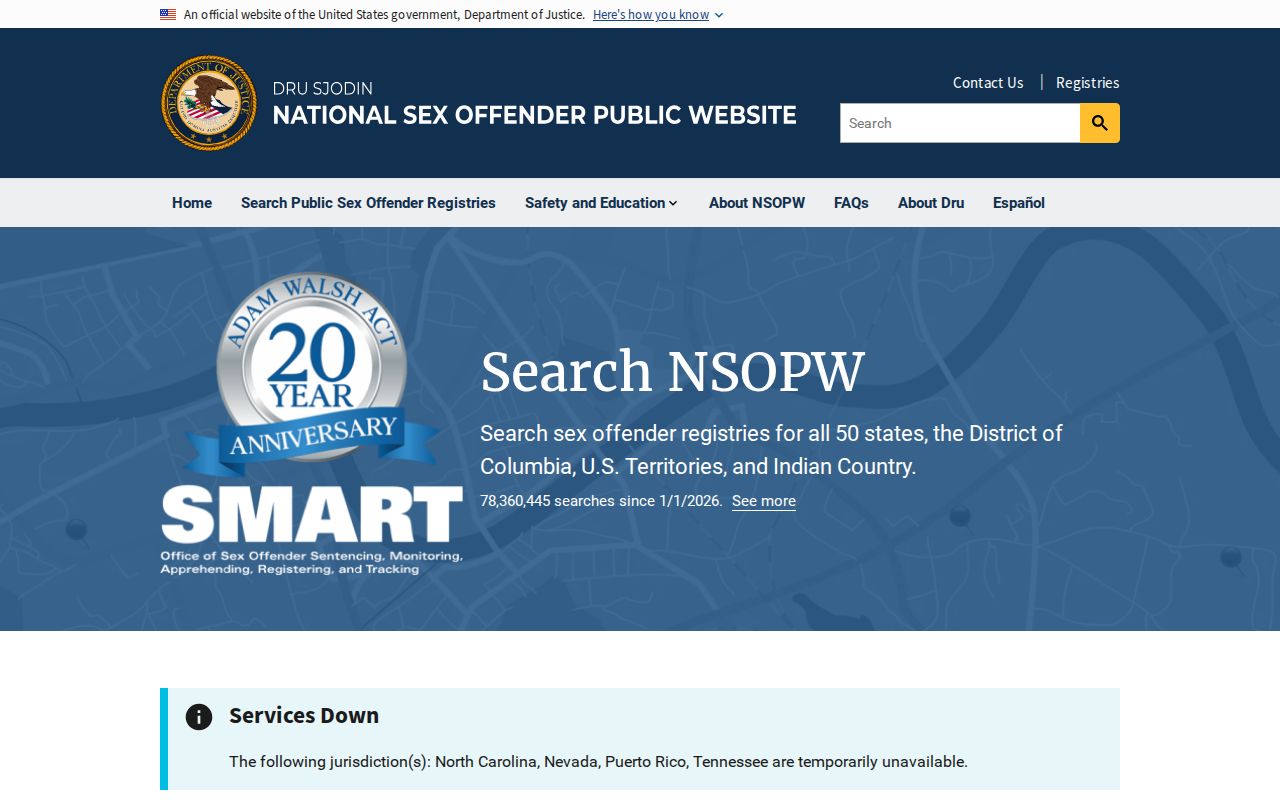
NSOPW advises users to verify information with the responsible jurisdiction. A national result does not replace Randolph County registration checks, and a national no-match does not broaden what Alabama law permits the public to see.
Registry Profiles: What They Show
Alabama Code §15-20A-8 supplies the reliable field inventory when the live profile layout cannot be inspected. The law requires the public website to provide identity, location, vehicle, physical, offense, and status information. It does not allow publication of a victim's identity, Social Security number, travel-document numbers, email or instant-message identifiers, Internet-service providers, or nonconviction arrest history.
| Name and aliases | Name plus aliases, nicknames, and ethnic or Tribal names reported for the registrant |
|---|---|
| Photo and description | A current photograph and physical description |
| Addresses | Each residence address, plus school and employer addresses when applicable |
| Vehicles | License plate and description for personally or occupationally used land vehicles, aircraft, and watercraft |
| Offense history | Each sex-offense adjudication or conviction and the text of the criminal provision |
| Status | Registration status, including whether the person is shown as absconded |
The public page must also offer a way to contest alleged errors and warn that ALEA has not made an individual assessment of each listed person's current risk or dangerousness.
Wrong Randolph County Registry Address
A stale or wrong address should be reported, not resolved through personal contact. Call the Randolph County Sheriff's Office at (256) 357-4545, option 2, for a local address discrepancy, a residence that may be too close to a protected place, or suspected failure to register. ALEA also publishes (334) 676-7898 and sexoffenderunit@alea.gov for its Sex Offender Unit.
Give the agency enough information to locate the public entry and explain the discrepancy. Law enforcement can check registration records and decide whether further inquiry is needed. The registry provides community notice; it does not authorize a resident to visit an address, confront anyone, or conduct surveillance.
Registration Levels and Duties in Alabama
Alabama does not publish the simple Tier I, Tier II, and Tier III duration chart used in some states. The adult framework under ASORCNA is generally lifetime registration with quarterly in-person reporting. Public visibility still depends on statutory category and case facts. This distinction matters in a Randolph County lookup because an omitted record may reflect a dissemination rule, not the absence of a conviction.
| Alabama Category | Duration or Visibility | Verification |
|---|---|---|
| Covered adult sex offender | Generally lifetime registration and public display | Birth month, then every three months |
| Juvenile adjudication | Not automatic; high-risk finding can permit adult-style notice | Case-specific under juvenile provisions |
| Youthful offender | Generally omitted unless over 18 at offense time | Depends on applicable status |
| First Indecent Exposure or Sexual Misconduct conviction | ALEA says it is not posted | Not shown as a public tier |
| Out-of-state, federal, military, or tribal conviction | May require a due-process hearing before posting | Determined through Alabama process |
Only offenses within §15-20A-5 are posted. The official code notes that Act 2026-375 amendments take effect October 1, 2026, so readers should check the current effective version when a specific offense category is at issue.
Randolph County Residence Rules
Under §15-20A-11, a covered adult generally may not reside within 2,000 feet of a school, childcare facility, resident camp, or a former victim's or immediate family member's residence. The statute has exceptions, and distance is measured in a straight line from property line to property line. A map estimate is not a legal measurement.
ALEA also states that a person convicted of an offense against a child under 12 may not loiter on or within 500 feet of listed places focused on children. These rules are tied to Alabama law and an individual's status. Direct a suspected violation to the sheriff or ALEA instead of trying to decide compliance from a public map alone.
Randolph County Community Notification
Alabama Code §15-20A-21 sets different notice distances by place. In qualifying cities with at least 5,000 residents, other than Alabama's four largest cities, the police chief or sheriff notifies residences within 1,500 feet and schools and childcare facilities within three miles. In municipalities under 5,000 and in unincorporated areas, sheriff notice reaches residences within 2,000 feet, while the three-mile school and childcare range remains.
Notice may be delivered by mail or hand and supplemented through electronic, newspaper, or posted means. No official source reviewed for Randolph County documented a separate address-proximity alert subscription or sheriff app. ALEA's CodeRED description covers other emergency alerts but does not clearly promise sex-offender proximity notices.
Community notice and a live registry search also serve different roles. A notice follows the statutory process for a qualifying address and location. The public search lets a reader check current official data when no notice arrived or after moving into Randolph County. Neither route replaces local verification. Report a suspected address mismatch or noncompliance to the Randolph County Sheriff's Office. ALEA also lists its Sex Offender Unit at (334) 676-7898 and sexoffenderunit@alea.gov for registry matters.
Using Registry Information Lawfully
The Randolph County registry is meant for awareness and sound safety planning. Check the official profile, keep the statutory exclusions in mind, and report a factual concern through law enforcement. ALEA's official registry guidance gives the governing rules and update context:
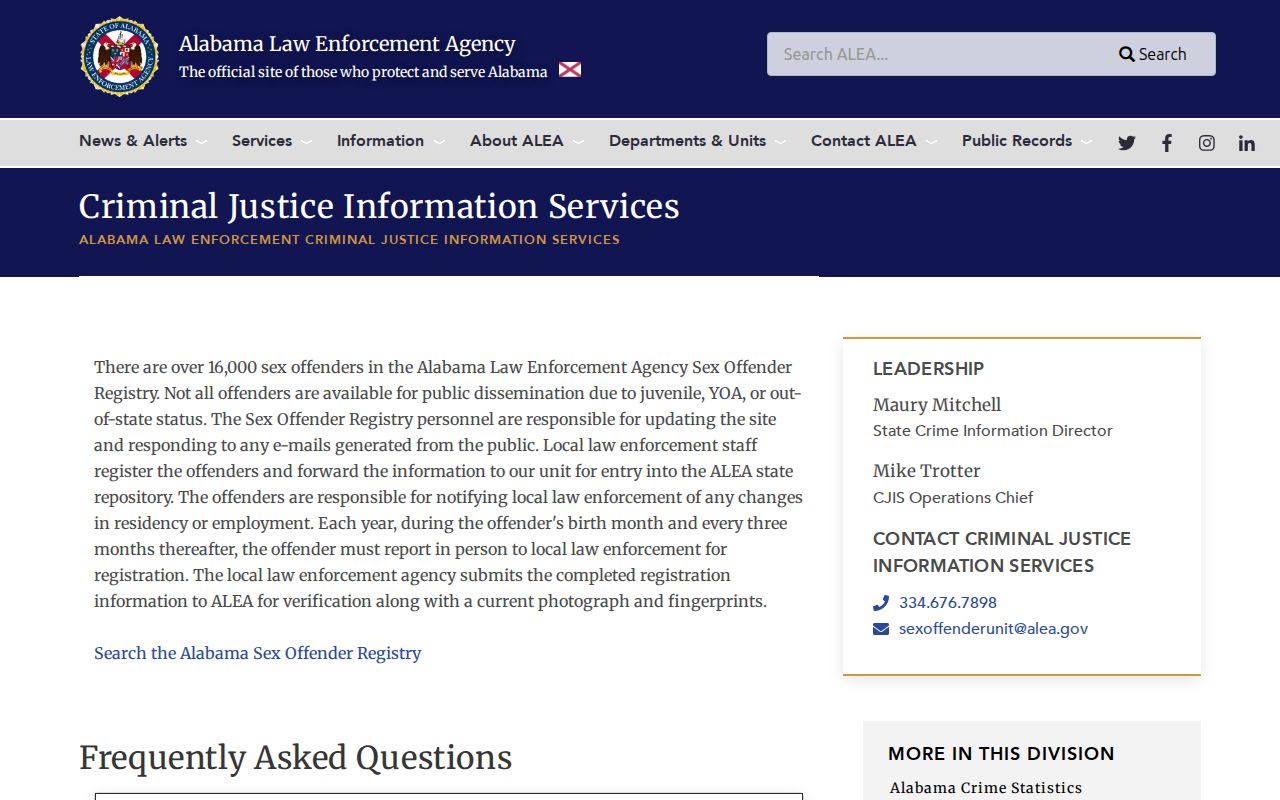
The guidance reinforces that data begins with local submissions and that public dissemination has limits. Registry information should never become a pretext for direct action against a listed person or household.
Misuse is unlawful: Alabama Code §15-20A-8 requires a warning against using registry information to injure, harass, or commit a crime. Threats, intimidation, harassment, or other misuse may lead to criminal prosecution or civil liability.